
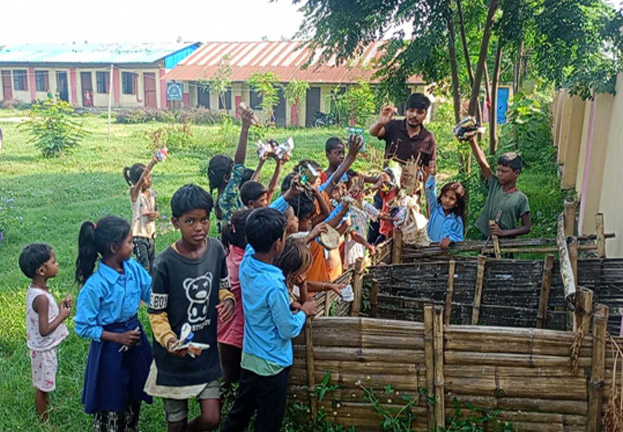
PTM4: Parent and Teacher Motivation Project is running on its 4th phase. Based in Chandra Nagar Rural Municipality of Sarlahi in Madhesh Province the project works with 10 schools under collaboration with the Municipality. It is considered one of the most deprived areas of Madhesh with lowest HDI indicators.
Its major objectives are to improve the quality of learning in public primary schools and strive for making public primary schools an issue of public discourse.
Main activities:
- Trainings, hands on support, inspirational incentives and reading materials to teachers.
- Physical quality enhancement- classroom improvements and greening school premises
- Promoting parental engagement in schools, door to door visits, parental meetingsand trainings.
- Connecting school and life- engaging parents in kitchen gardening, imparting traditional skills to students in schools.
- Training the cadres of parent organizations and build alliances and reach out to more people.
- Watching education through media, policy, cases and researches.
- Interacting with policymakers and opinion makers.
The project also supports advocacy in Municipal, Provincial and Federal levels towards its mission. Its fourth phase will last until mid-2026. It’s mainly staffed by an inclusive local staff.
Main achievements: In our working schools number of parents going to school to inquire about the learning status of their children has been increased; smaller children enjoy floor sitting arrangements and natural playing materials in school premises.Schools were able to construct flower and kitchen gardens together with students and teachers greening the premises in general.
We have been advocatingto speed up the School Education.Wehave continued to work with the media and the Federation of SMCs. We have formulatedAdvocacy Strategy and Parent Mobilisation Strategy thathave given a good foundation for the advocacy and parent mobilisation.The partnership with SHIKSHAK magazine we have been working to bring-up the educational issues of Madhesh Province. Our weekly news and views also seek to shape the mind-set of the concerned.
PTM4 is supported by Misereor since 2014 although the base was changed to Chandra Nagar since 2018! Over 10% of the budget is complemented by Thousand Current.
HEEEP: Haku Environmental and Educational Enhancement Project (HEEEP) based in Haku in AmaChhodingmoRural Municipality. Haku denotes a cluster of villages in the eastern facing slope opposite to Dhunche, thedistrict headquarters of Rasuwa. While it is culturally, rich environmental situation of Haku range isprecarious with many landslides risking houses and even the whole village. The project works with 5 schools the community under a collaboration with the Municipality. It is considered one of the mostdeprived areas of Mountain region with lowest HDI indicators.
 Objectives: Improve the quality of learning and natural environment with augmentation of nutrition and futureincome possibilities of the people of Haku.
Main Activities:
- Conduct teacher training and subsequent follow ups.
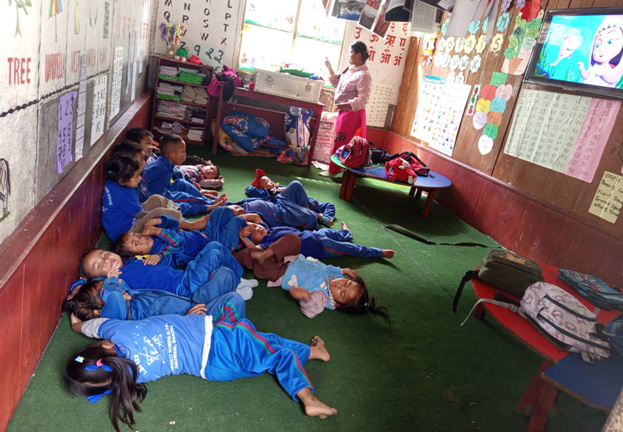
- Improving classrooms to make them more suitable for young children – pedagogically, climatically.
- Establishing tree, fruit or fodder nurseries from where people can bring saplings to plant in andaround landslides including on private land. Nurseries are also expected to work as places oflearning environmental issues for children.
- Encouraging parents to establish home gardens that combine fruits and vegetables for consumption with future possibility for income.
First Phase was operated for 2021-2024; second phase will continue for next two years.
Main achievements: Children’s results in schools slightly improved, schools become relatively attractive for both children andparents which is evident from increased attendance of students and parents to keep an eye.Parents start demanding accountability from teachers.Interest and prevalence of kitchen gardens and fruit saplings in the area has increased.Cleanliness is also seen improved in the villages. The schools slowly indicate how learning is important over building and benches.
It is supported by BIKAS since 2021.
PFCE: Child and Environmental Education Program has been running in collaboration with locally-based Forum for Educational Awareness since January 2023 in six schools in Bagmati Rural Municipality (BRM), Makawanpur District, located on the west bank of the Bagmati River and the Chure Mountain Range. This is the continuation of CEPP’s other projects since 2014.
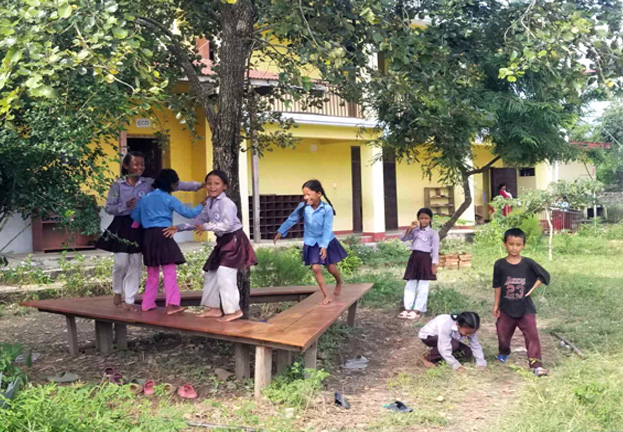
Objective: of this program is to improve the physical and learning environment of schools and to create positive awareness among parents about environmental protection.
Main Activities: To train teachers on different skills, hold parents meetings, greening the schools with the participation of students and teachers as well as their homes, with parents and SMCs. Classroom upgrading with floor sitting for smaller children that has been one of CEPP’s signature activities was initiated here. In the PFCE, the emphasis is on localization.
Main Achievements: Parents’ interest in schools has increased, and they are gradually increasing their conversations and inquiries with teachers about their children’s studies.Budget in education of the BRM has increased. School management committees have been formed and federated. Teachers’ teaching skills and efficiency in general have increased. The Education Act of BRM has made provision for a SMC network. Ward Education Committees have also been formed in every ward. We also collaborated in preparing curriculum for the ‘local’ subject.
This project is funded under a strategic grant from Thousand Currents for 2023-2025.
This project also extends it support to 5 schools at the other side of the river: HaiharpurGadhi Rural Municipality on a combined support from HE Space mediated and supported by retired teacher duo CarineVerleye and Paul Beke who act as CEPP nodal points in Belgium.